
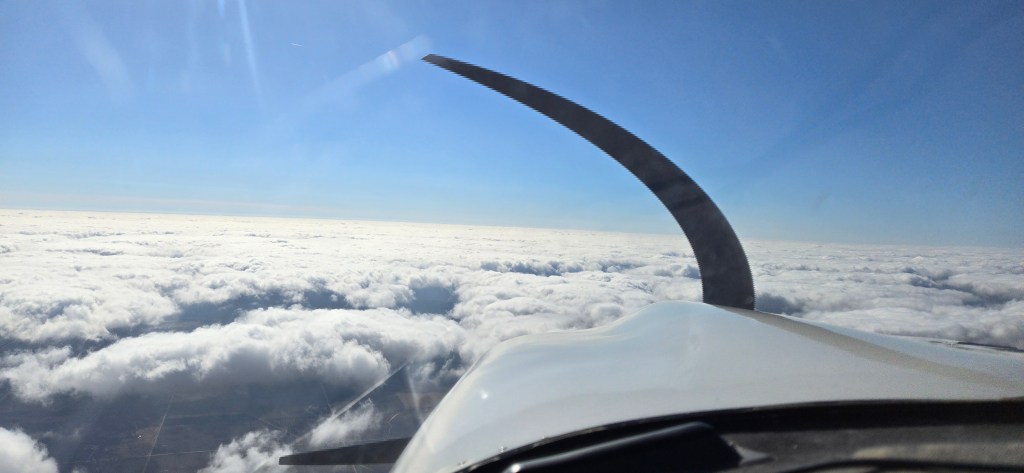
For the past 6 months, I had been training and studying towards my Instrument Rating. An Instrument Rating allows the pilot to fly solely by instruments in the plane without visibility outside. This is helpful to fly in cloud cover and the pilot does not get disoriented.
The journey to obtaining an Instrument Rating requires passing a written test, oral test, and a practical test. For my written test, I used Sheppard Air to prepare for it. After spending many long days, I was able to achieve a 100% on the test!
The oral and practical test are done on the same day by a Designated Pilot Examiner (DPE). To prepare for this, I trained with my instructor 3-4 times a week for almost 6 months! After he was confident that I am ready for it, he gave me the endorsement to schedule a check ride with a DPE. I called a few DPEs in the area and was able to get on the schedule with Steve Anderson, who is based out of St. Cloud (KSTC). Steve only schedules appointments three weeks in advance, which allows for greater flexibility in scheduling check rides. Other DPEs are booked for multiple months. After a few text messages, Steve was able to schedule me in for 3 weeks out. For the next 3 weeks, I worked with my instructor to ensure I am fully prepared for it.
The following is a detailed walkthrough of the preparation of the check ride and the check ride itself. It is intended to assist other pilots working towards their Instrument Rating in understanding what to expect.
Pre-planning
For my oral test, I thoroughly studied the book Instrument Pilot Oral Exam Guide. This helped me prepare for all types of Q&A that the examiner may ask. My instructor quizzed me on the questions and that also ensured that I knew what was needed. Additionally, we went through the plane’s maintenance logs and Pilot Operating Handbook to confirm that I knew every detail about the plane I was planning on using for the check ride.
As the date got closer, I started a binder for all the documents I would need to have ready in case the examiner asked for those. I used the checklist that was in the Exam Guide’s Appendix. This checklist included:
- Aircraft Documents
- Aircraft Maintenance Records
- Personal Equipment
- Personal Records
The aircraft documents were already in the plane and the maintenance records was a large binder already provided by my instructor. The personal equipment included my foggles, iPad and any other documents which were already in the iPad. Personal records was my pilot certificate, medical certificate, etc.
The binder had:
- Written test
- Personal Minimums
- Printed logbook
- Endorsements
- Plane’s maintenance history with inspection and due dates
- Medical certificate
A few days prior to the check ride, the DPE gave me a route to plan for. We were expected to fly from St. Cloud (KSTC) to Osh Kosh (KOSH) with a few friends and some luggage. As I planned this trip, it became apparent why he had suggested this route. I would need to fly through an MOA and depending on winds, I may need to make a fuel stop due to weight in the airplane.
The morning of the check ride, the weather had suddenly taken a turn. Winds had picked up and cloud ceiling had come in. Also, the assumed flight to KOSH had changed. The wind direction for the route had changed and there were low clouds at KOSH. I would need to account for these changes during my oral test.
Early morning, I was still not sure I would be able to make it to the check ride if the weather did not clear up. Fortunately, the clouds were high so I could fly to KSTC, which took ~20 minutes. During the flight there I found the winds were turbulent with high gusts. For my personal flight, it was not a big concern, but for a check ride, it was borderline. I was committed to get this done and confident in my ability to perform the maneuvers required for the check ride.
Oral Exam
I met with the DPE at the airport’s FBO. He walked me back to the hangar and we sat down for a long discussion. He started by checking my personal documents and charged my credit card for his evaluator fees. For the test, he started discussing the flight route I had planned. I mentioned that since winds had become favorable, I would not need a fuel stop, but I would not go due to the cloud ceilings and freezing temperatures would result in icing.
This led to a discussion about weather and how I checked weather. I had checked Aviation Weather and 1800WxBrief, which are the legal sources where a pilot should be checking weather for planning. To my surprise, he mentioned that I could access the same data through ForeFlight!
Leading this conversation, he wanted to know if I knew the capabilities of ForeFlight and what I can use it for during flight. I explained that it serves as a substitute for paper charts, including sectionals, approach plates, and airport supplements. It cannot be used as IFR navigation tool, as the GPS in the plane is the only primary tool I can use.
Following up on this, he wanted to know more about the equipment in the plane. He wanted to know that since the plane has two G5s, which equipment in the 6-pack is primary and which can be substituted by the G5s. It led to a debate whether the turn coordinator is required or I can use the G5 as a substitute. Finally, I had to pull out the POH to confirm my point that I still need the turn coordinator and it cannot be substituted by the G5. You know you are doing well, when the examiner has to accept that he was wrong!
There was additional discussion about whether the Garmin unit has a VOR capability. If it does, my plane is equipped with dual VORs. Although I insisted it does not have VOR capability, I could not prove it. He insisted that it does and that I should know about the equipment in my plane. This discussion came up again after the practical test.
We had some more Q&A and then it was time to go for the practical test.
Practical test (Attempt #1)
After he was satisfied with the oral exam, he walked me through what would encompass the practical test. We would start our flight to KOSH as planned. He would play the role of Minneapolis Center as we would not be flying an actual IFR flight plan. Due to the strong winds, he decided we would stay near the KSTC airport. After our initial departure, we would do unusual attitudes, and then come back for RNAV 23. Going missed from there, we would perform the ILS 13. The check ride would end with an approach on VOR 31 since runway 31 was currently being used by the airport.
After I did my preflight, he checked the airplane documents to ensure it was airworthy. Due to the winds, on his recommendation, I requested a departure on runway 23. We took off and I had to struggle to maintain altitude and heading due to the gusting winds. Despite the challenging winds, I successfully executed the unusual attitudes to his satisfaction. He would provide vectors, playing the role of MSP Center and then ask me to contact KSTC Tower when we would be established on the approach. He asked me to hold at JALTI on the RNAV 23 approach. Although the GPS suggested a direct entry, I performed a parallel entry since it was my decision as we were coming from the south. He was a bit surprised by this as he had to ask what I was planning on doing. He accepted my decision since the entry was acceptable, given our approach angle.
After the hold, we did the approaches as we had planned. I had to struggle to maintain heading and altitude throughout due to the gusting winds. I think he also gave me some margin due to the wind factor. In calm winds, I am not sure if my approaches would have been acceptable.
On the final ILS 13 approach, he gave me the option to circle to land on runway 23 if I preferred. I wanted to avoid a circle to land but the winds were out of 240. It would have been a very strong crosswind on runway 13 so I decided to circle to land. As we were coming in to circle for 23, the strong winds pushed me further out than anticipated and I overshot the runway. We did a missed approach and performed a go around. I landed and taxied back to the FBO and shut down the engine. Now, if the DPE has not said anything so far, the assumption is that the check ride was a success! Unfortunately, that was not the case. He had to fail me due to not being able to perform the circle to land and I would need to come back for that.
While we debriefed on the ramp, he mentioned that he tried getting the VOR on the Garmin but realized that it was not capable of doing VOR on that. Surprisingly, he insisted that I need to know about the equipment in my plane, forgetting that I was insistent that it does not have VOR capability.
After going through the paperwork, he handed me the letter confirming that I had failed the circle to land and I needed to perform that again.
Over the next week, I spent a few hours with my instructor to practice the maneuver. After getting his endorsement, Steve was able to schedule me in again within a couple of days.
Practical test (Attempt #2)
For my second try, I met with Steve at the FBO at St. Cloud. He checked my documentation again and completed the paperwork. Since the winds were calm, the runway 13 was in use by ATC. He told me that we will be flying out from runway 13, perform RNAV 23 and then circle to land on runway 13.
As I did previously, I made sure to perform all the checklist items and got the plane ready to go. As planned, we departed from runway 13, after which he provided vectors to establish ourselves on RNAV 23. During that time, he also asked me to put on my hood. Even though winds were calm, I think I was nervous and for that reason I was not able to hold the plane at an altitude consistently. He ignored it since I was making the appropriate corrections.
After we started the approach on RNAV 23, I came to the minimums and he let me come out from under the hood. I turned to circle to land for runway 13 on a visual approach. Even though I kept it really close to the runway, I was able to make it a nice and smooth descent. After we landed and parked at the FBO, he gave me the good news that I had finally passed.
With this great news, I had finally achieved my Instrument Rating!
In wrapping up this chapter of my aviation journey, I can’t help but reflect on the whirlwind of challenges and triumphs that have marked my pursuit of the Instrument Rating. From the intense study sessions to the unexpected twists and turns of the check ride, each moment has been a testament to dedication and perseverance. I owe a debt of gratitude to my instructor, whose unwavering support propelled me forward, and to the Designated Pilot Examiner, whose guidance was invaluable. As I proudly hold my Instrument Rating in hand, I’m filled with an exhilarating mix of accomplishment and anticipation for the adventures awaiting me in the vast expanse of the skies. With newfound skills and confidence, I eagerly look forward to soaring to new heights and embracing the boundless opportunities that aviation has to offer.


Leave a comment